
The hard and soft wadding production line has become an indispensable technical asset in the global nonwoven sector, primarily due to its ability to manipulate fiber density and structural integrity through controlled thermal bonding. In modern textile engineering, the distinction between "soft" and "hard" wadding is defined by the thermal fusion of low-melting-point fibers with carrier fibers. By leveraging a high-performance hard and soft wadding production line, manufacturers can transition from producing high-loft, breathable insulation to rigid, high-density structural panels used in construction and automotive sectors.
The Energy Saving Type Soft Wadding Production Line is specifically engineered to handle fine-denier fibers, typically ranging from 1D to 25D. This process relies on a precise balance of temperature and airflow within the oven to ensure that the low-melting-point fibers bond at their cross-points without collapsing the air pockets that give the material its "loft." This specialized production line maintains a surface density of 250–300gsm, a specification that is critical for thermal retention in bedding and premium clothing fillings.
The energy-saving design of the soft wadding production line allows for a stable line speed of 3–15m/min. With a maximum finished width of 3800mm, these systems are frequently utilized to manufacture primary air filter products and greenhouse insulation. The thickness of the finished product, ranging from 50mm to 80mm, provides the necessary depth for sound-absorbing products while ensuring the material remains lightweight and compressible for logistical efficiency.
The Thermal Bonded Hard Wadding Production Line utilizes a different mechanical compression logic to achieve higher surface densities, often reaching 400–3000gsm. Unlike soft wadding, this system is designed to process not only virgin chemical fibers but also recycled synthetic and natural fibers. This versatility makes it a sustainable choice for producing high-density mattress cores, seat cushions, and traditional Japanese-style tatami mats.
Thermal bonded hard wadding production lines feature robust calibration tools to manage a finished product thickness of 10mm up to 200mm. By adjusting the pressure of the calibration rollers and the residence time within the heating zone, the production line creates a rigid internal matrix. This structural rigidity is essential for air filter materials and heavy-duty acoustic panels that must maintain their shape under mechanical stress. The system's capacity of 150–600 kg/h ensures it can handle high-volume industrial orders without compromising the uniformity of the fiber distribution.
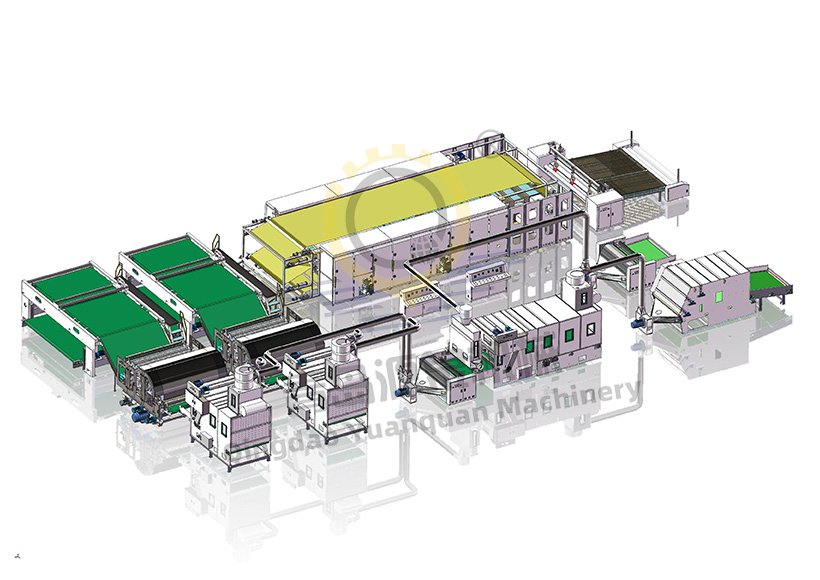
A customized hard and soft wadding production line offers various configurations, such as bale opening types for raw material preparation or specialized mixing types for complex fiber blends. Manufacturers can opt for double-head thermal bonded lines or integrate two mixing machines to achieve a more homogeneous fiber matrix. The hard and soft wadding production line operates on a standard 380V/50Hz 3-phase voltage, but the internal motor systems can be tailored to the specific line speeds (up to 20m/min) required by the client’s production targets.
The strategic deployment of a hard and soft wadding production line allows a single facility to serve multiple vertical markets. For instance, the same production environment can produce electric vehicle windshield quilts in the morning and high-density mattress fillings in the afternoon by recalibrating the density and thickness settings. This operational flexibility is the primary driver for the adoption of hard and soft wadding production line technology in the competitive B2B landscape of textile machinery.
Aishan Industrial Zone, Yanghe Town, Jiaozhou,Qingdao City, Shandong Province.
Copyright © 2024 Qingdao Yuanquan Machinery Co.,Ltd All Rights Reserved.
 Powered by HiCheng
