
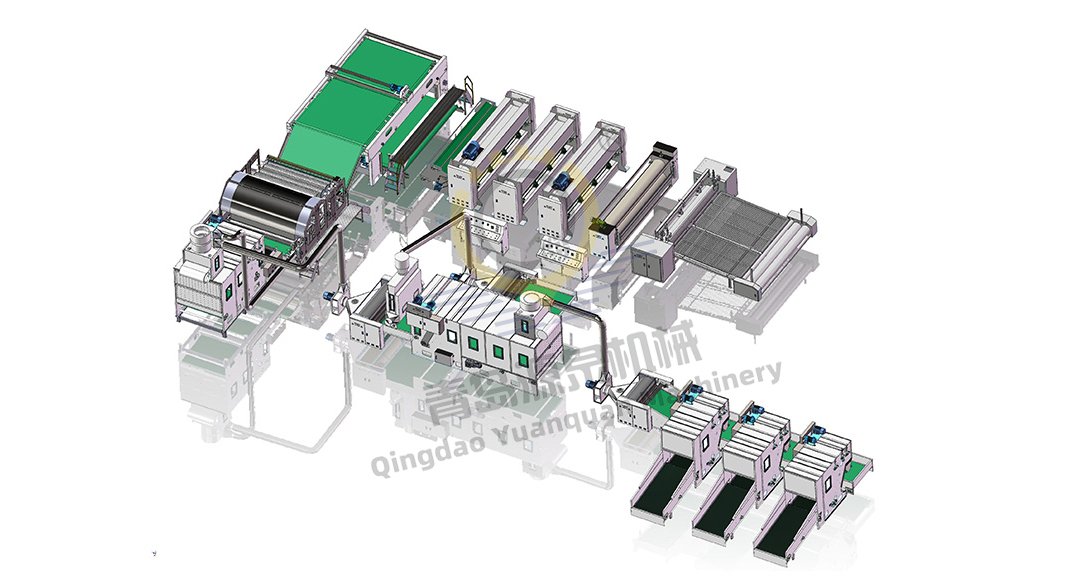
In the production of technical non-woven fabrics, structural strength is achieved not through chemicals, but through high-precision mechanical bonding. A high-performance needle felting machine serves as the functional core of the production line, utilizing thousands of barbed needles to physically interlock fiber webs into cohesive materials. Qingdao Yuanquan Machinery’s latest needle loom production line is engineered for high-volume processing of sheep wool, polyester, and other chemical fibers, catering to the 2026 global demand for geotextiles, automotive interiors, and industrial filtration.
Needle felting machine efficiency is rooted in the principle of vertical fiber displacement. As the needle beam reciprocates, the barbs catch surface fibers and drag them through the web, creating a dense structure without needing any chemical binders. This versatility allows the line to handle a vast weight range, from lightweight 80g decorative felt to heavy-duty 600gsm industrial substrates. With a maximum working width of 2500mm, the system provides the flexibility required to switch between diverse applications, such as synthetic leather bases or thick quilt materials.
The transmission mode enables a stable line speed of 1–8m/min. Maintaining consistent punch density across the entire web relies on the synchronized 380V (3-phase) 50 HZ power system integrated into the Yuanquan design. For specialized products like scouring pads or linoleum base fabrics, this stability is paramount. Any fluctuation in throughput speed would directly impact the finished thickness—which is adjustable between 5mm and 80mm—or compromise the overall tensile strength of the non-woven roll.
needle felting machine precision is the foundation for various specialized non-woven configurations. Because the production line is highly customizable, it supports dedicated setups for carpet production and automotive interior non-woven fabrics. In terms of capacity, the line reaches a significant output of 100–600 kg/h (optimized for sheep wool). After the automated trimming phase, the finished product can reach a maximum width of 2600mm, ensuring the output meets standardized logistics and installation requirements for global industrial buyers.
Aishan Industrial Zone, Yanghe Town, Jiaozhou,Qingdao City, Shandong Province.
Copyright © 2024 Qingdao Yuanquan Machinery Co.,Ltd All Rights Reserved.
 Powered by HiCheng
