
The non woven machine has fundamentally redefined the parameters of textile production, moving away from traditional weaving or knitting processes toward high-efficiency mechanical, thermal, and chemical bonding. In the current global industrial landscape, the adaptability of a non woven machine is measured by its ability to process a vast spectrum of synthetic and natural fibers—ranging from virgin polyester to recycled cotton—into high-performance materials. As manufacturing requirements shift toward sustainability and precision, the technical architecture of a non woven machine must now integrate advanced automation with low-energy consumption protocols.
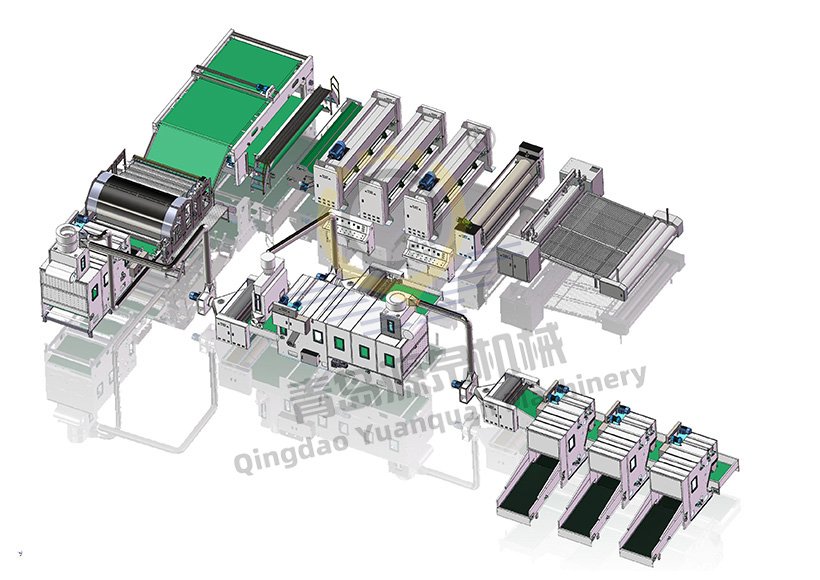
A professional non woven machine is rarely a singular unit but rather an integrated sequence of specialized modules designed to transform raw fiber into a finished web. The process begins at the fiber preparation stage, where the non woven machine ensures a homogeneous mixture of carrier fibers and bonding agents through sophisticated bale opening and blending systems. This initial stage is critical for maintaining the structural integrity of the final product, as any inconsistency in fiber distribution can lead to physical weak points in the finished fabric.
The carding component of a non woven machine utilizes high-precision cylinders and working rollers to align fibers into a uniform, multi-layered web. For manufacturers focusing on hygiene or medical-grade textiles, the non woven machine must be calibrated to handle micro-denier fibers with extreme delicacy. By adjusting the mechanical settings of the non woven machine, operators can precisely control the surface density (gsm) and porosity of the material, enabling the production of everything from lightweight surgical masks to heavy-duty industrial geotextiles.
The thermal bonding unit of a non woven machine serves as the heart of the stabilization process. By applying controlled heat and pressure, the non woven machine fuses low-melting-point fibers at their contact points, creating a durable matrix without the need for chemical adhesives or aqueous binders. This "dry" process, central to any modern non woven machine, is what allows for the production of high-loft wadding and rigid insulation panels. The energy efficiency of a non woven machine in this phase is determined by its thermal recovery system, which recirculates heated air to minimize operational costs and carbon footprints.
Calibrating a non woven machine for different thicknesses—ranging from a few millimeters for clothing interlinings to 200mm for mattress cores—requires a sophisticated control interface. High-end non woven machine models are equipped with real-time sensors that monitor the web's uniformity as it passes through the bonding oven. This ensures that the non woven machine produces a consistent product across the entire working width, which can extend up to 3800mm in specialized industrial configurations.
The application of a non woven machine spans multiple vertical industries, providing essential materials for the automotive, construction, and healthcare sectors. In the automotive industry, a non woven machine is used to create sound-absorbing panels and trunk liners that meet strict acoustic and safety standards. Meanwhile, in the agricultural sector, the same non woven machine technology can be adapted to produce UV-resistant greenhouse insulation quilts that protect crops from extreme temperature fluctuations.
Investing in a versatile non woven machine allows factories to pivot their production based on fluctuating market demands. Whether the goal is to produce primary air filter media or high-density mattress padding, the non woven machine provides the mechanical flexibility to switch between fiber types and bonding intensities. This versatility, combined with a production capacity that often reaches 600 kg/h, positions the non woven machine as a vital asset for any B2B textile enterprise looking to scale its operations globally.
The future of the non woven machine lies in the seamless integration of AI-driven diagnostics and sustainable material processing. As the industry moves toward a circular economy, the modern non woven machine is being re-engineered to handle an increasing percentage of recycled and biodegradable fibers without compromising tensile strength or thermal properties. Qingdao Yuanquan Machinery Co., Ltd. continues to lead this transition by developing Non Woven Production Line solutions that prioritize modularity and long-term durability.
As a critical driver of industrial innovation, the non woven machine is no longer just a piece of hardware but a comprehensive manufacturing solution. Through continuous R&D and a commitment to engineering excellence, the next generation of the non woven machine will empower manufacturers to achieve unprecedented levels of precision, ensuring that the nonwoven industry remains at the forefront of global material science and sustainable development.
Aishan Industrial Zone, Yanghe Town, Jiaozhou,Qingdao City, Shandong Province.
Copyright © 2024 Qingdao Yuanquan Machinery Co.,Ltd All Rights Reserved.
 Powered by HiCheng
